
Price crawling (also called price intelligence or competitive price monitoring) is no longer a “nice-to-have.” In manufacturing and aftermarket spare parts, it has become one of the fastest ways to detect margin leakage, correct mispricing, and support commercial teams with facts—not opinions. This connects closely with structured pricing governance and AI-supported decision frameworks discussed in my article on AI-Powered Strategy
But most companies fail at price crawling for one simple reason: they treat it like a scraping project instead of a pricing capability.
This blog gives you a practical, real-world playbook you can apply this week.
1) What price crawling is (and what it is not)
Price crawling is the structured collection of market price signals across competitor websites, marketplaces, and distributors—then turning that into decisions (not just data).
Price crawling is NOT
-
a daily “copy competitor price” exercise
-
a one-time benchmark
-
a dashboard that nobody uses
Your goal is to convert market signals into pricing actions that protect margin and improve win-rate.
2) Where price crawling creates the biggest value in spare parts
In industrial spare parts, price crawling delivers the highest value in these situations:
A) High-volume, visible items
-
frequently searched parts
-
common wear parts
-
items customers compare online
B) Price-volatile supply chains
-
components with supplier price swings
-
items impacted by freight, lead time, or material costs
C) “Silent margin killers”
-
legacy prices never updated
-
wrong units of measure / pack size confusion
-
manual pricing errors
3) The 7-step framework that makes price crawling work
Here’s the exact operating model to make it practical and scalable:
Step 1 — Define “crawl scope” (don’t start with everything)
Start with one segment:
-
Top 200–500 revenue parts
-
or Top 200 “most quoted” parts
-
or Top 200 items with highest margin uncertainty
Step 2 — Normalize product matching (this is the hardest part)
In spares, matching is everything. Build rules for:
-
OEM number vs competitor number
-
alternates / equivalents
-
unit of measure (per piece / per meter / per pack)
-
currency, VAT, and shipping assumptions
If matching is weak, the crawl is useless.
Step 3 — Convert prices into “apples-to-apples”
Your internal price vs market price must be comparable:
-
remove VAT if needed
-
normalize shipping assumptions
-
align pack size / UoM
-
convert currency at a consistent FX rate (weekly is enough)
Step 4 — Create “price corridors” (not one target price)
Instead of a single “market price,” set a corridor:
-
Low market bound (aggressive competitor)
-
Median / typical
-
High bound (premium channel)
This protects you from reacting to one extreme outlier.
Step 5 — Add business rules (so the system can recommend actions)
Example rules:
-
If you are > +20% above median and item is high visibility → review price
-
If you are below market by >10% and demand is stable → increase price cautiously
-
If item is project-based / engineered → crawling is only a signal, not a driver
-
If there’s stock scarcity → don’t follow low market price blindly
Strong price crawling systems also require governance — clear ownership, validation rules, and accountability — to ensure recommendations are trusted and consistently applied. AI Governance: Turning Control into Competitive Advantage
Step 6 — Turn insights into workflow (tickets, not dashboards)
The best systems produce actions:
-
“Review price” ticket with evidence
-
“Increase price” recommendation with corridor justification
-
“Mismatch detected” ticket (bad matching/UoM)
If there’s no workflow, nothing changes.
Step 7 — Measure impact like a business case
Track outcomes:
-
margin uplift
-
win-rate improvement on key quoted items
-
reduction of pricing exceptions
-
time saved vs manual checks
4) Common traps (and how to avoid them)
Trap 1: Crawling without segmentation
Fix: start with one controlled segment and expand.
Trap 2: Comparing list price vs promo price
Fix: label price type (list vs discounted vs marketplace dynamic).
Trap 3: Overreacting to the lowest price online
Fix: use corridors, not single-point comparisons.
Trap 4: Poor matching = false conclusions
Fix: invest in matching rules and UoM normalization early.
5) What to do this week (simple starting plan)
If you want real progress in 7 days:
-
Pick 200 parts (top revenue or most quoted)
-
Identify 3–5 competitor/distributor sources
-
Normalize: currency + VAT + UoM + pack size
-
Calculate corridor: low / median / high
-
Flag only 3 categories:
-
Overpriced vs median
-
Underpriced vs median
-
Possible mismatch / data issue
-
-
Create a pricing review workflow (ticket or tracker)
-
Measure uplift opportunity (even rough estimate is fine)
This is enough to show value quickly—and to justify scaling
The diagram below shows how price crawling becomes an operating capability rather than a scraping task.
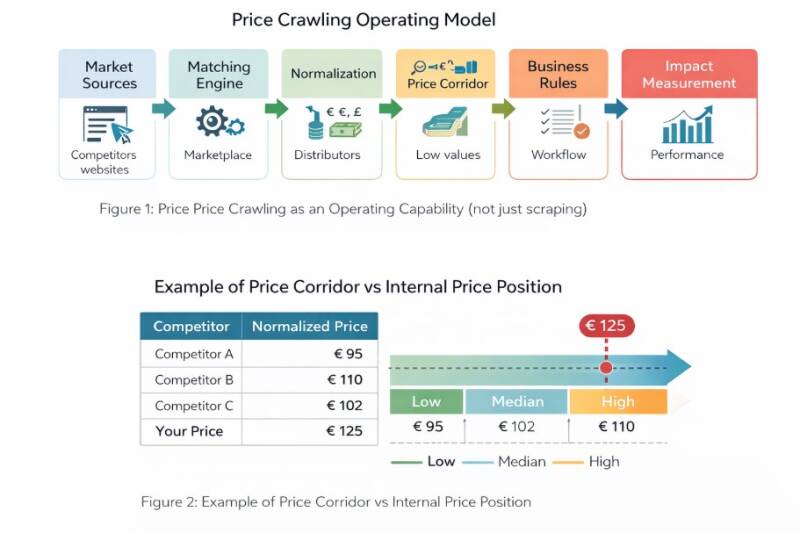
The diagram above demonstrates how structured normalization transforms raw competitor prices into a defined price corridor. Positioning your internal price within this corridor enables disciplined, data-driven pricing actions instead of reactive adjustments.
Final thought
After working on price crawling throughout all of 2025, my biggest takeaway is simple: price crawling only creates value when it becomes an operating capability, not a one-time analysis. The data is the easy part—real impact comes from disciplined matching, normalization, corridors, clear rules, and a workflow that turns insights into decisions.
At the same time, price decreases require extra caution. Before reducing any price, always do the correct analysis—an apples-to-apples comparison is a must. Even within the same webshop, differences like pack size, unit of measure, VAT/shipping, availability, product variants, or hidden discounts can create false signals. Never reduce prices based on the “lowest price seen online” unless you’ve validated it is truly the same item and the same buying conditions.
If you build price crawling this way, it stops being a dashboard project and becomes a reliable engine for margin protection, faster quoting confidence, and smarter pricing actions—week after week.
FAQ: Price Crawling in Manufacturing
Is price crawling legal?
Yes, when collecting publicly available price data from websites and marketplaces. Always ensure compliance with local regulations and website terms of service.
How often should manufacturers update crawled prices?
For most industrial spare parts, weekly normalization is sufficient. Highly volatile categories may require more frequent monitoring.
Should you always match the lowest competitor price?
No. Reacting to the lowest price online can destroy margin. Use price corridors and matching validation before any adjustment.
Can AI automate product matching?
AI can significantly improve matching accuracy, especially for alternate part numbers and unit-of-measure inconsistencies, but governance and validation rules are still required.
Add comment
Comments