Introduction
For years, business decisions followed a familiar pattern:
experience, intuition, and historical data.
That model is now under pressure.
Markets are moving faster. Costs are more volatile.
And the volume of data is no longer manageable through traditional methods.
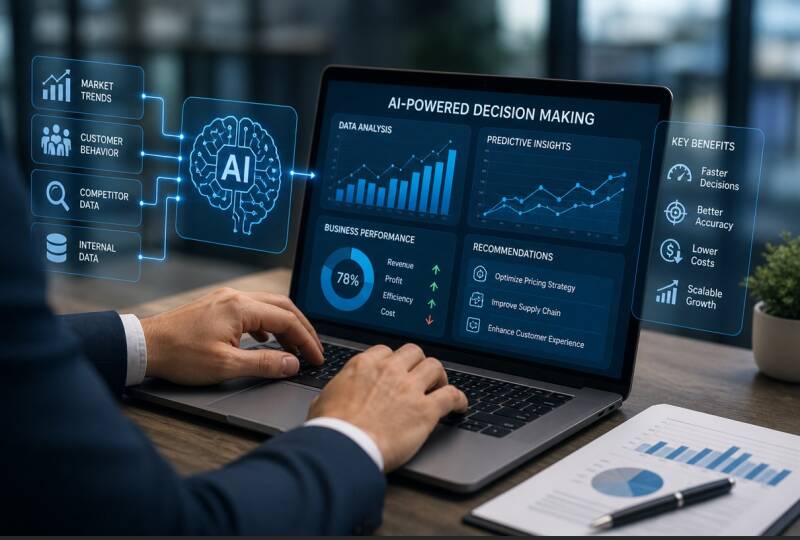
This is where AI is not just helping—it is reshaping how companies think, decide, and act.
The Shift: From Experience-Driven to Data-Augmented Decisions
Traditionally:
- Managers relied on experience
- Decisions were made with limited data
- Analysis was often backward-looking
Today:
- Data is real-time
- Markets change weekly—not yearly
- Decisions need to be faster and more consistent
👉 The result: companies are moving toward AI-augmented decision-making
Not replacing humans—but enhancing them.
Where AI Is Already Making Impact
1. Pricing Decisions
AI helps:
- Analyze competitor movements
- Track cost changes (energy, logistics, materials)
- Recommend price adjustments
👉 Result: faster, more structured pricing actions
2. Demand Forecasting
Instead of static forecasts:
- AI adjusts based on real-time trends
- Detects shifts in demand early
👉 Result: better inventory and planning decisions
3. Procurement & Cost Management
AI identifies:
- Supplier price patterns
- Cost anomalies
- Better sourcing options
👉 Result: improved cost control
4. Customer Interaction (Chatbots & AI Assistants)
Companies are increasingly using AI for:
- Customer service
- Internal support (HR, IT, procurement)
- Sales assistance
👉 Result: faster response, lower operational cost
The Real Value: Speed + Consistency
The biggest advantage of AI is not just automation.
It is:
- Speed → faster decisions
- Consistency → same logic across teams
- Scalability → apply decisions across markets
👉 This is critical in today’s volatile environment.
The Risk: Faster Decisions, Wrong Direction
AI is powerful—but not perfect.
Without proper governance:
- Decisions can be based on wrong data
- Bias can be amplified
- Teams may rely too much on automation
👉 This is why AI must be controlled—not blindly trusted.
The Role of Leadership
Leadership must shift from:
- Making every decision
To:
- Designing how decisions are made
This includes:
- Defining rules
- Setting boundaries
- Ensuring accountability
👉 AI supports decisions—but leadership owns them.
What Companies Should Do Now
- Start small but structured
- Focus on pricing, forecasting, or customer support
- Ensure data quality
- AI is only as good as the data behind it
- Build governance early
- Define when AI can recommend vs decide
- Train teams
- AI is a tool—people must know how to use it
Final Thought
AI is not just a technology shift—it is a decision-making shift.
My experience shows that companies that succeed are not those using the most AI,
but those using it with structure, governance, and clarity.
👉 The future is not “AI replaces decision-makers.”
👉 It is AI strengthens decision-making—making it faster, more consistent, and more scalable.
Add comment
Comments