Introduction
AI adoption often starts with excitement: a new tool, a successful pilot, and ambitious plans for productivity and transformation. Then usage slows, employees return to familiar processes, and the tool never becomes part of everyday work. The problem is often not the technology, but the approach.
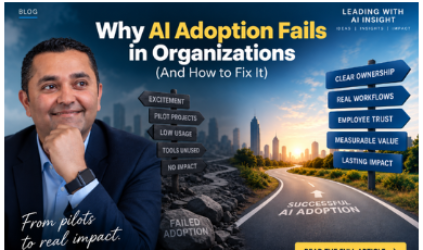
From what I have observed, successful AI adoption is not just a technology implementation. It is an organizational transformation built on ownership, workflow, trust, measurement and leadership.
1. Nobody Really Owns the Outcome
One of the first problems is surprisingly simple.
Who owns AI success?
IT may implement the system.
Finance may approve the budget.
Business functions may receive access.
Leadership may sponsor the initiative.
But who is responsible for making sure AI actually creates measurable value?
Sometimes the answer is:
Nobody.
And when nobody owns the outcome, adoption quickly becomes optional.
The solution is not necessarily creating a huge AI department.
It is creating clear accountability.
Someone needs responsibility for questions such as:
- Are people actually using it?
- Is it improving the process?
- What problems are emerging?
- What value is being created?
- What needs to change?
AI adoption needs an owner, not merely an implementation team.
2. Companies Train People on AI Instead of Their Actual Work
AI training has become common.
Employees learn about prompting.
They see demonstrations.
They attend workshops.
They may even receive certificates.
But knowing how an AI tool works does not automatically change how someone performs their job on Monday morning.
That is where many programs stop too early.
The real question is not:
“Do employees understand AI?”
It is:
“Can they use AI to solve a problem they actually face?”
A pricing professional needs pricing examples.
A procurement professional needs sourcing examples.
A finance team needs financial workflows.
A manager needs decision-support examples.
Generic AI training creates awareness.
Workflow-specific implementation creates adoption.
3. The Tool Doesn't Fit the Work
Another common mistake is introducing an impressive AI tool and then expecting employees to redesign their work around it.
That is often backwards.
People already have established processes.
ERP systems.
Excel files.
Approval steps.
Customer interactions.
Supplier data.
Reporting routines.
If an AI solution creates additional steps, requires duplicate data entry or sits outside the normal workflow, employees may simply stop using it.
Even a technically powerful tool can fail if it makes the job more complicated.
Before introducing AI, organizations should understand:
How is the work actually being done today?
Then ask:
Where can AI remove friction?
That is very different from asking employees to use AI simply because the company bought it.
4. Organizations Measure Usage Instead of Value
A company can proudly report:
2,000 employees have access to the AI platform.
That doesn't tell us very much.
Neither does:
70% completed AI training.
The more important questions are:
Did quotation time improve?
Did errors decrease?
Did margins improve?
Did employees spend less time preparing reports?
Did managers receive information faster?
Did customer response times improve?
AI adoption should eventually connect to business outcomes.
For example:
Pricing: faster analysis, better margin quality, fewer inconsistent prices.
Procurement: faster benchmarking, better supplier intelligence.
Operations: reduced manual processing, fewer errors.
Sales: shorter preparation time, faster customer response.
Leadership: quicker access to reliable decision information.
The objective should not be maximum AI usage.
The objective should be measurable improvement.
5. Resistance Is Often Rational
When employees resist a new AI system, organizations sometimes assume they simply dislike change.
That can be a mistake.
Resistance may come from legitimate concerns.
People may wonder:
Will this eventually replace my role?
Can I trust the output?
Who is responsible if the AI makes a mistake?
Is this really saving me time?
Am I now expected to do the same work plus manage another system?
Those are reasonable questions.
Ignoring them doesn't make them disappear.
It usually pushes resistance underground.
Employees may technically have access to the tool while quietly avoiding it.
Successful adoption therefore requires conversation.
Explain why the technology is being introduced.
Show where it helps.
Be transparent about limitations.
Allow users to influence how the solution develops.
People support change more easily when they understand it and have some ownership of it.
What Successful AI Adoption Looks Like
The organizations that make AI useful tend to follow a different pattern.
Start With the Problem
Don't begin with:
“We have AI. Where can we use it?”
Begin with:
“What business problem are we trying to solve?”
Slow quotation preparation?
Too much manual reporting?
Poor market-price visibility?
Repeated data formatting?
Difficulty comparing suppliers?
Once the problem is clear, AI becomes one possible solution rather than the objective itself.
Build Around the Workflow
Good AI should disappear into the process.
It should make work easier, faster or more reliable.
For example:
Instead of asking a pricing professional to leave their normal environment, upload information into several systems and manually transfer the result back, a better solution integrates AI into the existing decision process.
The less friction the technology creates, the more naturally adoption happens.
Give Someone Ownership
Someone should be able to answer:
Is this initiative succeeding?
That person does not need to be the most technical person in the organization.
But they need enough authority to coordinate business, technology and users.
Without ownership, pilots remain pilots.
Measure Something That Matters
Before implementation, define what success looks like.
Not:
Number of prompts.
Not:
Number of AI users.
But business outcomes.
For example:
Reduce market research time from three hours to thirty minutes.
Improve quotation turnaround by 25%.
Reduce manual data preparation.
Identify margin leakage earlier.
Increase the percentage of pricing decisions supported by reliable market information.
Now the organization can determine whether the AI initiative deserves to continue.
My View: AI Adoption Has Three Layers
I think organizations can simplify the challenge by looking at AI adoption through three layers.
Technology
Does the AI actually work?
Is the data reliable?
Is it secure?
Process
Does it fit naturally into the workflow?
Does it remove work or create more?
People
Do employees understand it?
Do they trust it?
Do they know when to challenge it?
Most failed AI initiatives focus heavily on the first layer.
Successful adoption requires all three.
Technology + Process + People.
Remove one, and the transformation becomes fragile.
AI Adoption Is Also a Leadership Test
AI exposes something interesting about organizations.
When responsibilities are unclear, AI projects expose it.
When processes are unnecessarily complicated, AI exposes it.
When departments don't collaborate, AI exposes it.
When employees don't trust leadership, AI exposes it.
This is why AI transformation is often less about installing new technology and more about confronting existing organizational weaknesses.
A tool cannot fix poor ownership.
AI cannot repair broken processes by itself.
And automation cannot create trust.
Those are leadership responsibilities.
The Biggest Mistake: Scaling Before Learning
Another pattern I would avoid is trying to transform the entire organization immediately.
Start smaller.
Choose a real business problem.
Implement the solution.
Measure the outcome.
Listen to users.
Improve it.
Then scale.
One successful use case that employees genuinely value can create more momentum than a company-wide AI announcement.
Adoption grows when people can point to something and say:
“This actually makes my job better.”
Final Thought
AI adoption will not succeed simply because organizations purchase better technology.
The difference will increasingly come from implementation discipline.
Clear ownership.
Real business problems.
Workflow integration.
Visible value.
Employee involvement.
Continuous improvement.
AI is certainly a technology challenge.
But once the technology works, the harder challenge begins:
getting the organization to work differently because of it.
That is why I believe AI adoption should be treated not as an IT project, but as a business transformation.
The companies that understand that distinction will move much faster than those that simply keep buying new tools.
Add comment
Comments